

PRODUCTS
CONTACT US
TEL: +86-532-85754589,85775618
FAX: E-Mail
E-MAIL: tlead.net@gmail.com; tlead.net@hotmail.com

Keywords: Pinless Wood Moisture Meter, Pinless Moisture Meters, Wood Moisture Meters, Moisture Meters
Accurate. Non-Destructive. Ready in Seconds.
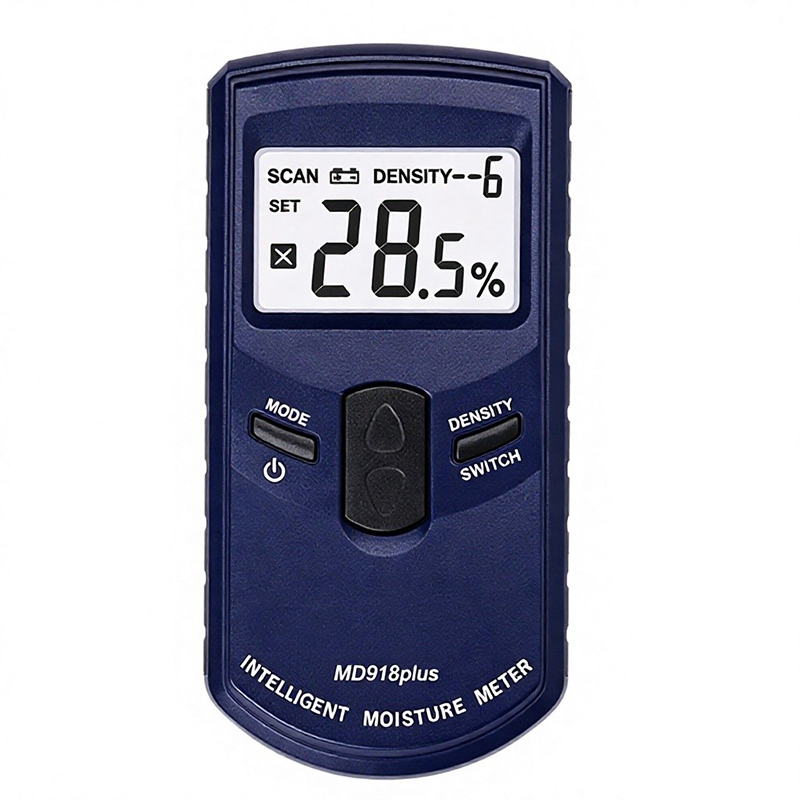
The MD918plus is a professional-grade pinless wood moisture meter designed for woodworkers, carpenters, flooring installers, firewood sellers, and lumber inspectors who need fast, reliable moisture readings without damaging the material being tested. Using advanced capacitance sensing technology, the MD918plus measures moisture content through the surface of wood and wood-fiber materials — no pins, no holes, no marks.
• True Pinless Measurement — Capacitive sensing reads moisture content without piercing the surface, making it ideal for finished lumber, furniture, flooring, and veneer.
• Automatic Temperature Compensation — Built-in auto-zero and temperature compensation eliminate the need for manual calibration, so every reading stays accurate as conditions change.
• 10 Wood Density Settings — Select from 10 density grades to match the specific timber species being tested, improving measurement precision across softwoods and hardwoods alike.
• Adjustable High-Moisture Alert — Set a custom upper moisture limit; the meter automatically alerts you when a reading exceeds the threshold, helping you catch problem lumber before it becomes a problem project.
• Large, Easy-Read LCD Display — An oversized LCD screen keeps readings clear in the shop, the lumberyard, or the job site.
• Low-Battery Indicator — A low-voltage warning tells you when it's time to swap batteries, so you're never caught off guard mid-project.
• Compact and Portable — At just 95 g and 132 x 67 x 26 mm (about 3.3 oz and 5.2 x 2.6 x 1.0 in), it fits easily in a tool bag or pocket.
Unlike pin-type meters that measure resistance between two inserted probes, the MD918plus uses capacitance (dielectric) sensing. Simply place the sensor plate flat against the wood surface, and the meter reads moisture content non-invasively — no drilling, no marring the surface, and no risk of leaving holes in finished or high-value material. This makes pinless moisture meters the preferred choice for flooring contractors, cabinet makers, and anyone working with material that needs to stay blemish-free.
| Measurement Range | 2% – 80% |
| Accuracy | ±2% + 0.5 |
| Resolution | 0.5% |
| Operating Temperature | 0°C – 40°C (32°F – 104°F) |
| Operating Humidity | 10% – 75% RH |
| Power Supply | 3 x 1.5V AAA batteries |
| Weight | 95 g (without battery) / approx. 3.3 oz |
| Dimensions | 132 x 67 x 26 mm / approx. 5.2 x 2.6 x 1.0 in |
| Sensing Method | Capacitance (pinless) |
| Density Grades | 10 selectable levels |
1. Power On/Off — Hold the MODE key for 2 seconds to power on; the display shows "SCAN." Hold again for 2 seconds to power off. To save battery life, the meter automatically shuts off after 5 minutes of inactivity.
2. Set Moisture Upper Limit — Press MODE to enter setting mode ("SET" appears), adjust the blinking digit, then confirm with MODE. Default upper limit is 90.0%.
3. Select Timber Density Grade — Press the DENSITY key to choose a grade (0–9) based on the wood species being tested, using the reference density table below. Grade 3 is the default setting.
4. Acclimate Before Use — For best accuracy, let the meter sit in the testing environment for at least 10 minutes before taking readings.
5. Take a Measurement — Power on, press the sensor flat against the wood surface, and read the moisture percentage directly on the LCD.
| Timber Species | Density | Grade | Timber Species | Density | Grade |
|---|---|---|---|---|---|
| Douglas Fir | 0.45 | 2 | Oak (Quercus) | 0.78 | 6 |
| Pine / Fir | 0.45 | 2 | White Pine / Sugar Pine | 0.35 | 1 |
| Cedar | 0.50 | 2 | Poplar | 0.45 | 2 |
| Alder | 0.47 | 2 | Radiata Pine | 0.37 | 1 |
| Aspen | 0.42 | 2 | Spruce | 0.43 | 2 |
| Ash (Manchurian / Chinese) | 0.60 | 3 | Shagbark Hickory | 0.60 | 3 |
| Linden | 0.37 | 1 | Black Walnut | 0.60 | 3 |
| Birch | 0.57 | 3 | Manchurian Walnut | 0.47 | 2 |
| Cherry | 0.50 | 2 | Beech | 0.65 | 4 |
| Cottonwood | 0.40 | 1 | Ormosia henryi | 0.82 | 7 |
| Cypress | 0.40 | 1 | Chicken Wing Wood | 0.80 | 6 |
| Elm | 0.58 | 3 | Rubber Tree | 0.65 | 4 |
| Redwood | 0.35 | 1 | Olive | 0.75 | 6 |
| Hemlock | 0.45 | 2 | Hard Firmiana | 0.35 | 1 |
| Hickory | 0.75 | 6 | Ipe | 1.00 | 9 |
| Larch | 0.58 | 3 | Iroko | 0.60 | 3 |
| Philippine Mahogany | 0.50 | 2 | Jatoba | 0.80 | 6 |
| African Mahogany | 0.50 | 2 | Keruing | 0.60 | 3 |
| Khaya | 0.50 | 2 | Keruing | 0.65 | 4 |
| Australian Mahogany | 0.85 | 6 | Merbau | 0.72 | 5 |
| Maple | 0.55 | 3 | Okoume | 0.40 | 1 |
| Eucalyptus saligna | 0.55 | 3 | Ramin | 0.55 | 3 |
| Scarlet Eucalyptus | 0.75 | 6 | Cumaru | 0.90 | 8 |
| Red Oak | 0.65 | 4 | Faber Oak | 0.70 | 5 |
Note: Select grade "0" for species with a density below 0.35.
Q: What's the difference between pinless and pin-type moisture meters?
A: Pin-type meters measure DC resistance between two probes inserted into the wood; pinless meters use AC capacitance sensing across a plate pressed against the surface. Pinless meters are faster and leave no marks, though pin-type meters can offer slightly higher accuracy in some conditions since they measure at a specific depth.
Q: Why do readings vary between different moisture meter brands or models?
A: Wood species, ambient temperature, and regional growing conditions all affect a material's electrical properties. Since most compact meters calibrate to a reference species and humidity level, different baseline assumptions can lead to small variations between devices.
Q: Does battery level affect accuracy?
A: Yes. Once battery voltage drops below roughly 70–80% of rated voltage, readings can trend lower than actual moisture content. Replace batteries promptly when the low-battery indicator appears to maintain accurate results.
Q: Do I need to calibrate the meter before each use?
A: No manual calibration is required — the MD918plus has automatic, temperature-dependent zero-point compensation built in. Just allow it to acclimate to the testing environment for about 10 minutes before use.